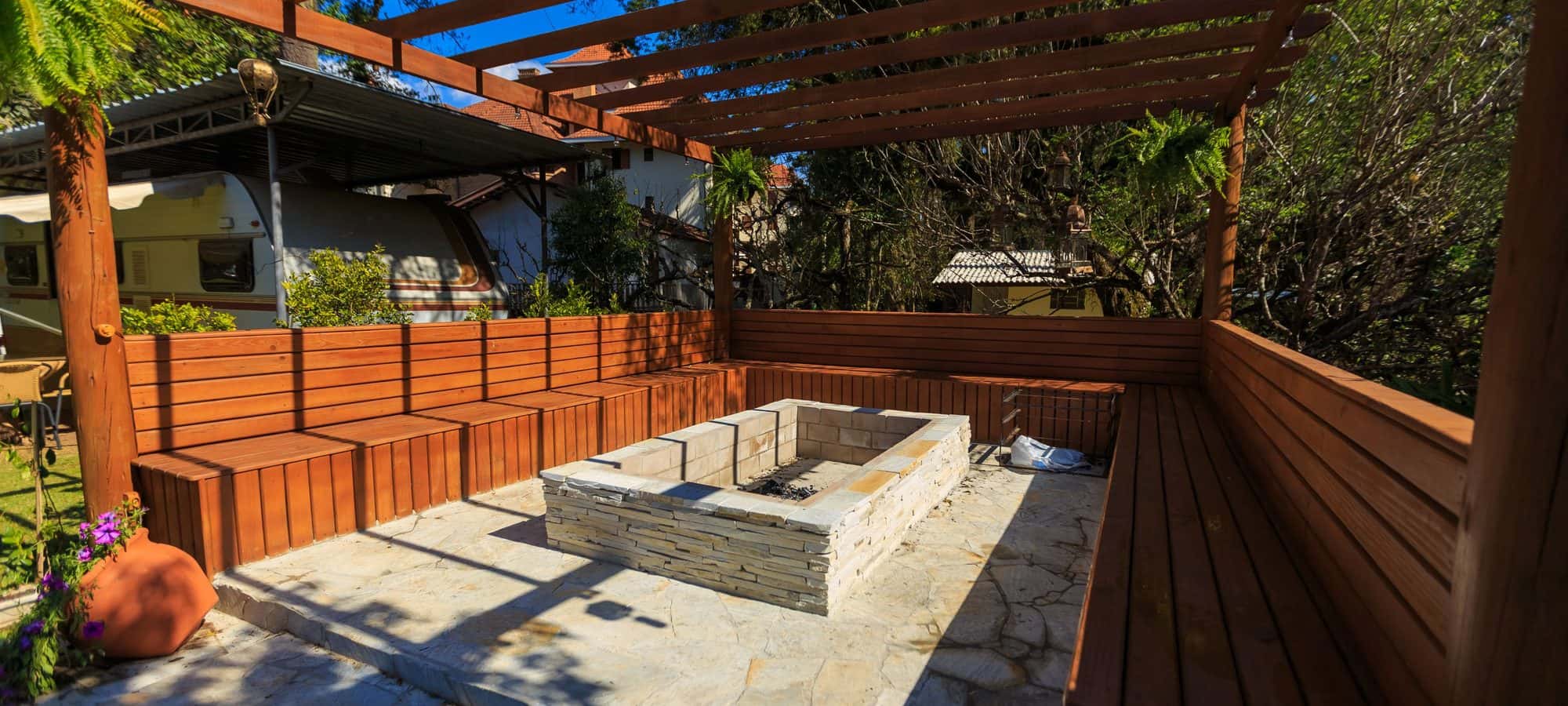
Hardscape & Outdoor Living
Paver patios, retaining walls and outdoor living spaces
Patios, walkways, retaining walls, outdoor kitchens and fire features, built on a base that will still be flat in fifteen years.
The base is the job
Class II base compacted in lifts to 95%, geotextile over clay, and depth matched to the load. It is invisible and it is where the money should go.
Walls engineered and permitted
Anything retaining over three feet, or carrying a surcharge from a slope or driveway above, gets stamped drawings and a City of Vista permit.
Five-year workmanship warranty
On settlement, joint failure and wall movement. Manufacturer warranties on pavers are typically lifetime against structural failure.
Hardscape is the part of a landscape that people notice last and complain about first. Nobody compliments a patio for being flat. But six years in, when one corner has settled two inches and there is a puddle by the back door every time it rains, it is the only thing you can see.
Almost every failed patio we are asked to fix failed underneath. The pavers are fine. The base was four inches where it needed eight, it was never compacted in lifts, or nobody accounted for the fact that half of Vista is expansive clay.
What proper base preparation looks like
For a residential patio on stable soil we excavate to a minimum of six inches below finished grade, install a woven geotextile separation fabric, then place and compact Class II aggregate base in two-to-three inch lifts with a plate compactor, not all at once, because a single thick lift only compacts at the top.
On expansive clay, which covers a lot of inland Vista, base depth goes to eight or ten inches and the fabric is not optional. For driveways and anywhere a vehicle turns, we go to ten to twelve inches. Then one inch of bedding sand screeded flat, pavers laid, edge restraint mechanically fastened, and polymeric sand swept and set.
This is why two paver bids can differ by forty percent for the same square footage and the same stone. Ask any contractor for their base depth and their compaction method in writing. If they will not put it on the proposal, that tells you something.
Materials that survive North County sun
Our UV load is high and our winters are mild, which changes the calculus compared to most of the country.
- Concrete pavers: the workhorse. Individually replaceable, no cracking, colour goes through the unit on better lines so chips are not obvious. Best value for large areas.
- Natural stone: flagstone, travertine and bluestone. Beautiful, cooler underfoot in travertine's case, more expensive to install because every piece is fitted.
- Poured concrete: fine for driveways and utility areas. It will crack; the question is whether the control joints put the crack where you chose. We do not recommend stamped concrete for large patios here because colour hardener fades unevenly in full sun.
- Segmental retaining wall block: for anything structural. Cores filled, geogrid where the engineering calls for it, and a drainage chimney behind the wall with an outlet.
Retaining walls and hillside lots
A large share of Vista, Bonsall and Fallbrook properties sit on a cut or fill slope. That makes retaining a structural question. A wall is holding a wedge of saturated soil that gets dramatically heavier in a wet February, and the walls that fail are almost always the ones with no drainage behind them.
Every structural wall we build gets clean drain rock against the back face, filter fabric to keep fines out of it, and a perforated pipe daylighted to somewhere that is not your neighbour's yard. Over three feet, or with any surcharge above (a driveway, a pool, a slope), it gets engineered drawings and a permit. That adds three to five weeks for plan check and inspection, and it is not a step to skip. An unpermitted wall becomes your problem at resale.
Outdoor kitchens, fire features and shade
The three things that actually get a backyard used here are shade, a heat source for the evening and somewhere to put a drink down. In our climate that is a better investment than almost anything else you can build.
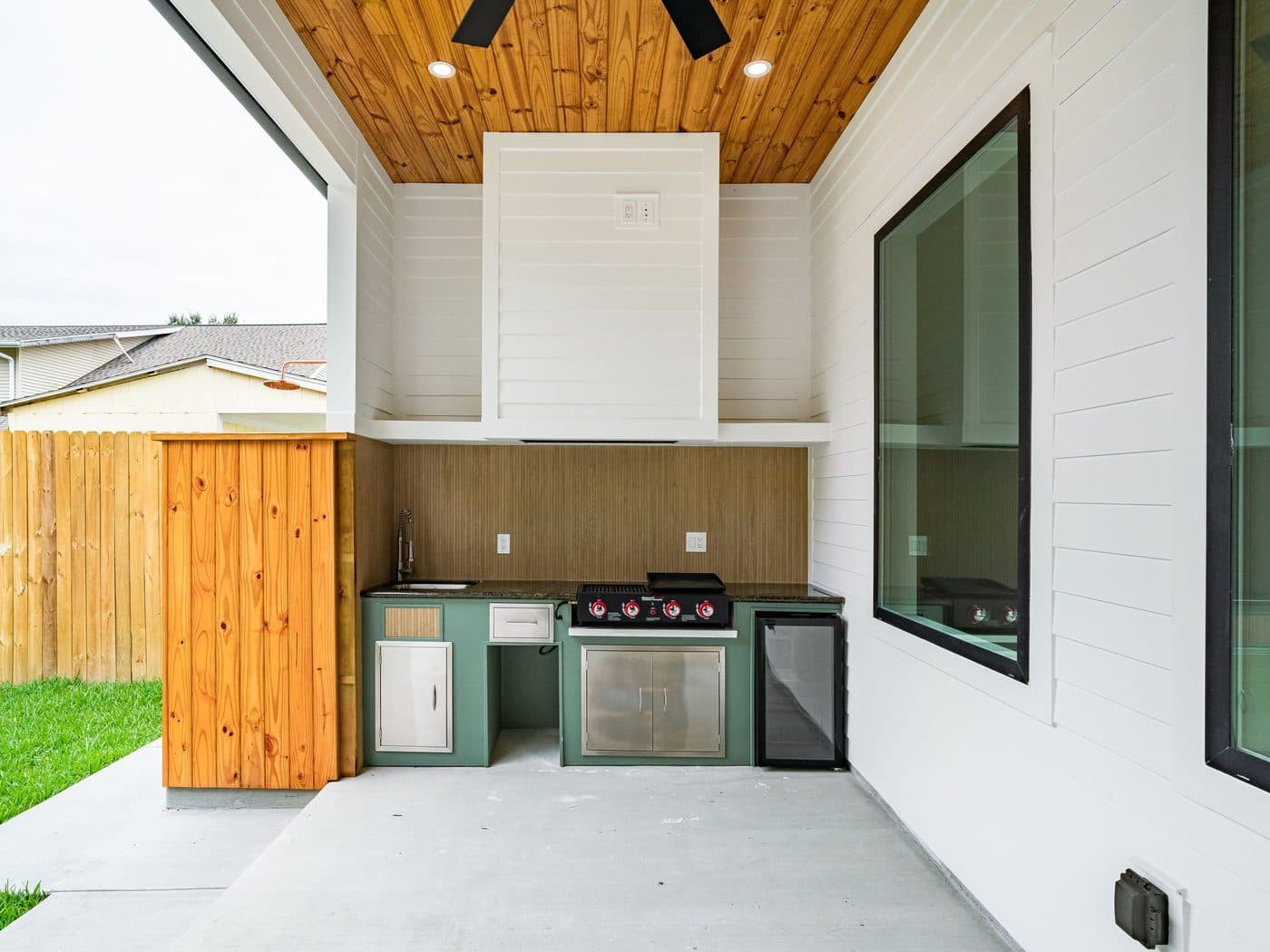
Outdoor kitchens are framed in steel stud rather than wood, backed with cement board and finished in stone, stucco or tile. Gas, water and a dedicated GFCI circuit get roughed in before the veneer goes on. For fire features, gas is the practical choice. The San Diego air district restricts wood burning on some winter days, and a gas fire pit gets used far more often because it turns on.
For shade, a solid-roof patio cover changes a west-facing yard more than any other single element. It also requires a building permit and a footing inspection, which we handle.
Drainage is part of hardscape, not a separate trade
Any time you add impervious surface you change where the water goes. A 600 square foot patio sheds roughly 375 gallons in a one-inch rain event, and that water has to have somewhere to go that is not the foundation.
We set patios at a minimum two percent fall away from the structure, tie in channel drains where a slope runs toward the house, and connect downspouts into a solid pipe system that daylights at the property line or into a dry well. It gets designed with the patio, not diagnosed after the first storm.
How it works
Our hardscape & outdoor living process
- 01
Layout and levels
We shoot elevations, mark the layout in paint and walk it with you before anything is excavated. Patios always look smaller on paper.
- 02
Engineering and permits
Structural walls and roofed covers go to an engineer and then to City of Vista plan check. We manage the submittal and the inspections.
- 03
Excavation and base
Excavate, fabric, then base compacted in lifts. We will show you the depth before it disappears.
- 04
Install
Bedding, laying, cutting, edge restraint and polymeric joint sand. Walls get drain rock, fabric and outlet pipe as they rise.
- 05
Clean-up and seal
Full site clean, optional penetrating sealer after a 60-day cure, and a written care sheet.
Questions
Hardscape & Outdoor Living FAQs
The questions we get asked most often about hardscape & outdoor living in North County.
Pavers or stamped concrete?
Pavers, in almost every case here. Stamped concrete is cheaper up front and looks good for about five years, then the colour hardener fades unevenly under our UV load and the control joints crack. Pavers flex with soil movement instead of cracking, individual units can be lifted and replaced if a tree root or a utility repair disturbs them, and a good paver holds colour through the unit rather than on the surface.
How long should a paver patio last?
Thirty years or more if the base is right. The pavers themselves effectively do not wear out. Most manufacturers warrant them against structural failure for life. What fails is base and edge restraint, which is why we put the money underground. Expect to re-sand the joints once every eight to ten years.
Do I need a permit for a retaining wall in Vista?
Generally yes once the wall retains more than three feet of soil measured from the bottom of the footing, and yes at any height if it carries a surcharge from a slope, driveway, pool or structure above it. Freestanding garden walls under three feet usually do not. We confirm with the City of Vista before we quote, and we pull the permit and schedule inspections as part of the contract.
Can you match pavers on an existing patio?
Often, but be realistic about colour. Even the same product from the same manufacturer will have drifted in shade over ten years of sun exposure, and a new section next to an old one will read as new. Where the match matters, we usually recommend a deliberate contrast, such as a different colour border or a banding course, which reads as intentional rather than as a repair.
Do you build pool decks?
Yes. Pavers around a pool are a good choice because they can be lifted for plumbing access and they run cooler than dark concrete. We use a permeable joint detail near the coping and set the deck to drain away from the pool so that deck water is not carrying dirt into the shell.
Often paired with
Related services
Landscape Design & Installation
Measured plans, a real budget before you commit, and one licensed crew that stays on your property from grading through the final plant.
Learn moreLandscape Lighting
Warm, low-glare LED lighting that makes a garden usable after dark, designed at night, on your property, before you buy it.
Learn moreIrrigation & Drainage
Leak diagnosis, drip conversion, smart controllers, and drainage that keeps winter storms out of your foundation.
Learn more
Free on-site estimate
Ready to talk about hardscape & outdoor living?
Free on-site walkthrough, a line-item estimate, and an honest answer about whether you need all of it.